How to Adjust the Truss Rod on a Bass Guitar to Fix Excessive Bow?
Does your bass guitar feel harder to play than it used to? Are the strings sitting too high above the frets, making your fretting hand work overtime? The truss rod is the key, and adjusting it correctly can transform your instrument from frustrating to effortless.
Many bass players avoid this task because it sounds technical or risky. The truth is that adjusting a truss rod is a straightforward skill that any bassist can learn. You do not need to be a guitar tech or a luthier to do this at home.
This guide walks you through every step of the process. You will learn what causes excessive bow, how to spot it, how to measure it, and how to fix it safely. You will also learn when to stop and call a professional.
Key Takeaways
- Excessive bow in a bass guitar neck means the neck curves forward (upbow), causing the strings to sit too high above the frets, which makes playing physically harder and causes intonation problems.
- The truss rod is a metal rod inside the neck that counteracts the pull of the strings. Tightening it (turning clockwise) reduces forward bow, and loosening it (turning counter-clockwise) adds relief.
- The ideal neck relief for a bass guitar is approximately 0.008″ to 0.012″ (0.20mm to 0.30mm) measured at the 7th or 8th fret when the first and last frets are fretted simultaneously.
- Always make small adjustments, no more than a quarter turn at a time, then wait at least 15 to 30 minutes before re-measuring to let the neck settle.
- Using the wrong size allen wrench or applying too much force can strip the truss rod nut, which leads to expensive repairs. Always use the correct tool for your specific bass.
- If the truss rod feels completely stuck or is already maxed out, stop immediately and take your bass to a qualified luthier to avoid permanent neck damage.
What Is a Truss Rod and Why Does It Matter?
The truss rod is a steel rod that runs through the inside of your bass guitar neck from the nut to the heel. Its entire job is to counteract the tension that the strings place on the neck. Bass strings produce a massive amount of pull, often between 150 and 200 pounds of total tension, which is significantly more than what a standard guitar neck handles. Without the truss rod working properly, that tension would bend the neck forward into an extreme curve.
The truss rod does not control your action directly. Your bridge saddles handle action height. The truss rod specifically controls the curve or relief of the neck. When the truss rod has the right tension, the neck maintains a slight, controlled curve that lets strings vibrate freely without buzzing on the frets.
There are two main types of truss rods. A single-action truss rod can only pull the neck backward to counteract forward bow. A double-action truss rod can push the neck in either direction, making it able to fix both excessive bow and backbow. Most modern bass guitars use double-action rods, but many vintage instruments still use the single-action design. Understanding which type you have matters because the adjustment process differs slightly between them.
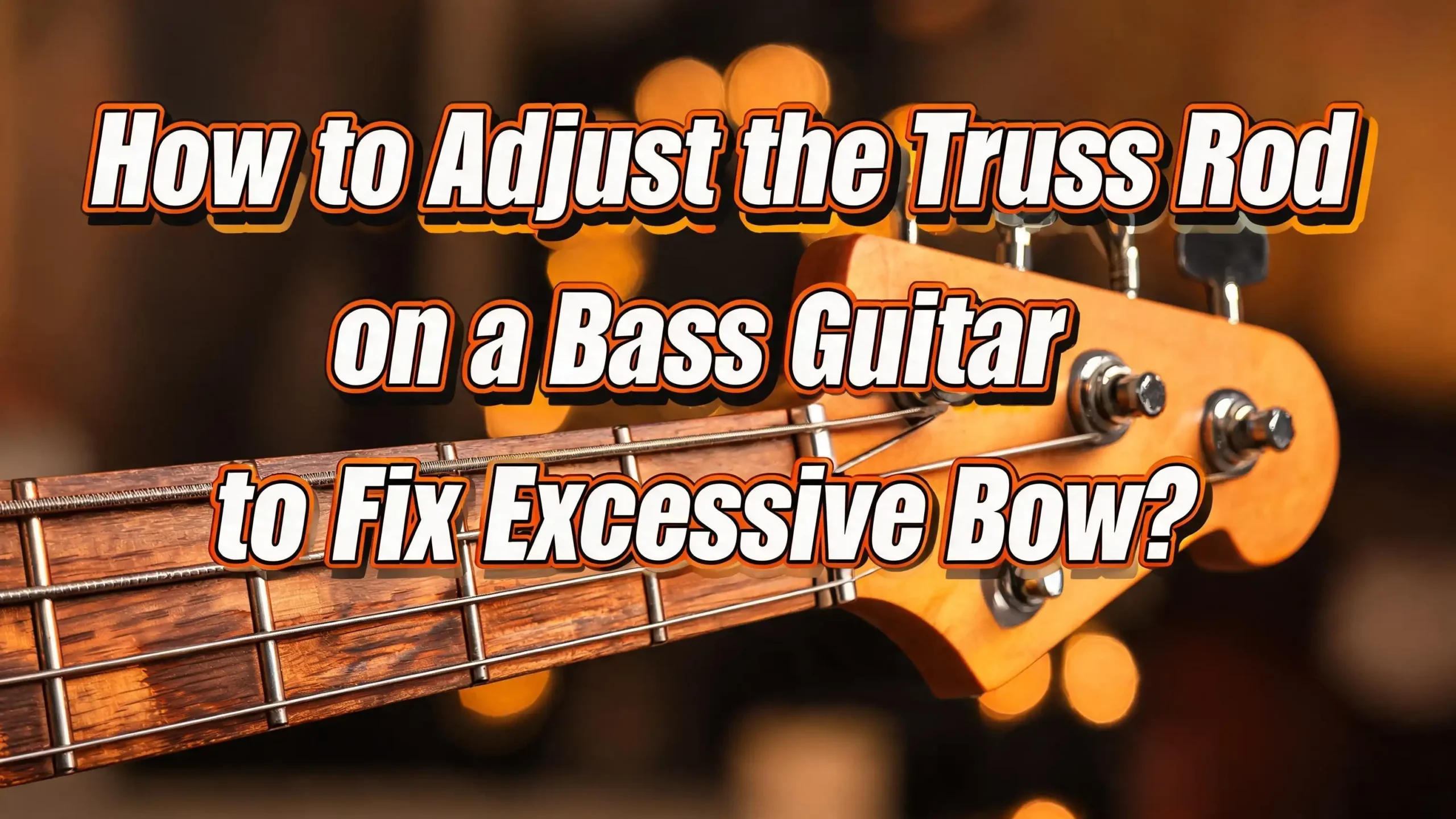
The truss rod nut is the part you actually turn during an adjustment. It sits either at the headstock end of the neck (covered by a small truss rod cover plate) or at the heel end where the neck meets the body. Knowing where your access point is before you start will save you a lot of confusion.
What Causes Excessive Bow in a Bass Guitar Neck?
Excessive bow, also called upbow or forward bow, happens when the neck curves too far toward the strings. The fretboard bows away from the player, which pushes the strings higher above the middle frets and makes those frets harder to press down. Several things cause this to happen.
String tension is the most common cause. When you tune up to standard pitch, your strings pull the headstock forward with considerable force. If the truss rod is too loose, it cannot counteract that pull effectively, and the neck curves forward more than it should.
Environmental changes play a huge role too. Wood is a natural material that responds to humidity and temperature. When humidity rises, the wood in the neck absorbs moisture and expands. This expansion often pushes the neck forward into excessive bow. Conversely, low humidity can cause a neck to dry out and shift position as well. If you live in a humid climate or store your bass in a humid environment, you may need to adjust your truss rod more frequently than players in drier climates.
Switching to heavier gauge strings is another cause. Heavier strings create more tension, which applies more pull to the neck. If you go from light gauge strings to medium or heavy gauge strings without adjusting the truss rod, your neck will almost certainly develop more forward bow.
Age is also a factor. On older instruments, the wood in the neck may have shifted gradually over decades of use, resulting in a neck that carries more permanent bow than a new instrument. In some of these cases, the truss rod may not be able to fully correct the issue, and more advanced repair may be needed.
How to Spot the Signs of Excessive Bow?
You can often feel excessive bow before you even measure it. The most obvious sign is high action in the middle of the neck. If your strings feel easy to fret near the nut and near the body but feel unusually stiff and high around the 5th to 9th frets, your neck is almost certainly bowed too far forward.
Another common sign is inconsistent intonation. When your neck has excessive bow, the scale length changes unevenly across the fretboard. You might tune your open strings perfectly, but chords and notes in the middle registers will still sound slightly sharp. This happens because the strings have to travel farther to reach the frets in the bowed section.
Fretting fatigue is another clue. If you find yourself pressing harder than usual to get clean notes in the middle register of the neck, and your fingers feel tired faster than normal, excessive bow is likely the cause. The strings are simply sitting too far from the frets in that area.
You can do a quick visual check by sighting down the neck from the headstock toward the body. Hold the bass up at eye level and look along the edge of the fretboard. A perfectly set neck should have a very slight, even curve. If you see a significant hump or banana-shaped curve in the middle, that confirms excessive bow.
You can also do a tap test. Press down the first fret and the last fret simultaneously. Then look at the gap between the bottom of the string and the top of the 7th fret. If you can fit a business card or more than roughly 0.012″ of space in that gap, your neck has more relief than recommended.
Tools You Need Before You Start
Getting the right tools together before you start will make the process smoother and safer. Trying to work with the wrong tools is one of the most common ways players accidentally damage their truss rod.
The most important tool is the correct size allen wrench (hex key). Different bass guitars use different sizes. The most common sizes are 4mm, 5mm, 1/8″, and 3/16″. Some basses like certain Fender models use a Phillips screwdriver-style slot on the truss rod nut instead of a hex fitting. Check your owner’s manual or manufacturer’s website to confirm the correct size before touching anything.
You will also need a feeler gauge set to measure neck relief accurately. A feeler gauge is a set of thin metal blades of precise thickness. For bass guitars, you are typically looking for a blade in the 0.008″ to 0.012″ (0.20mm to 0.30mm) range. Feeler gauges are inexpensive and widely available at hardware stores and auto parts stores.
A capo is helpful for holding down the first fret while you measure relief. This frees up both hands for using the feeler gauge and checking the result. If you do not have a capo, you can use your fretting hand to hold down the first fret, but a capo makes measuring much easier.
You may also want a straightedge if you want to check the neck without string tension. A metal ruler or a dedicated guitar neck straightedge works well for this purpose. A digital caliper is optional but useful for more precise measurement if you want to go beyond feeler gauge accuracy.
How to Find the Truss Rod Access Point on Your Bass?
Before you can make any adjustment, you need to locate the truss rod access point on your specific bass. The two most common locations are the headstock and the heel of the neck.
Headstock access is the most common location on modern bass guitars, especially Fender-style instruments. You will usually see a small plastic or metal cover plate near the nut at the top of the headstock. It is held in place by two or three small screws. Remove those screws, take off the cover, and you will see the truss rod nut inside a small cavity. Some basses do not have a cover at all, leaving the nut exposed and easily accessible.
Heel access is common on some bolt-on neck basses. On these instruments, the truss rod nut sits at the point where the neck meets the body. Adjusting a heel-access truss rod without removing the neck requires a special long-reach allen wrench or a purpose-built truss rod adjustment tool. Some players remove the neck entirely to make the adjustment easier, especially when the access cavity is tight.
A few modern bass guitars, particularly Music Man style instruments, feature a wheel-style truss rod adjuster accessible through a small hole on the side of the neck or headstock. These are the easiest to adjust because you can turn the wheel with your fingers or a coin without any tools.
Once you have located your access point and confirmed the correct tool size, you are ready to begin the adjustment process.
How to Measure Neck Relief Accurately
Measuring neck relief correctly before and after adjustment is the most important step in this process. Without accurate measurements, you are adjusting blindly, which can lead to overcorrection in either direction.
Start by tuning your bass to standard pitch. The neck must be under normal string tension for the measurement to be accurate. Do not measure with loose or detached strings.
Next, place a capo on the first fret. This holds the strings down at the nut end without requiring your hand. Then use your fretting hand to press the string down at the last fret or the fret where the neck meets the body, which is typically the 17th to 21st fret depending on your bass.
Now look at the gap between the bottom of the string and the top of the 7th or 8th fret. This is the standard measurement point for neck relief on a bass guitar. Slide your feeler gauge blades into that gap one at a time to find the one that fits snugly without forcing it.
The recommended neck relief for bass guitars is approximately 0.008″ to 0.012″ (0.20mm to 0.30mm). Some players prefer slightly more relief for a looser, more forgiving feel, while players who prefer lower action often like slightly less. The 0.010″ (0.25mm) mark is a great starting target for most players and most styles of music.
If your measurement shows a gap larger than 0.015″ or more, your neck has excessive bow and needs the truss rod tightened. Write down your measurement so you can track your progress after each adjustment.
Step-by-Step Guide to Tightening the Truss Rod
Now comes the actual adjustment. Follow these steps carefully and you will fix excessive bow without risking any damage to your instrument.
Step 1: Gather all your tools. Make sure you have the correct size allen wrench, your feeler gauge, a capo, and a tuner nearby. Lay your bass on a padded surface like a folded towel or a guitar mat to protect the finish.
Step 2: Loosen the strings slightly. You do not need to fully detune them, but reducing the string tension slightly before turning the truss rod takes pressure off the nut and makes turning easier. Detune each string by about a half step.
Step 3: Insert the correct allen wrench into the truss rod nut. Make sure it seats fully and securely in the socket. A loose fit is a warning sign that you may have the wrong size wrench.
Step 4: Turn clockwise to tighten. Righty-tighty applies here. Turning the nut clockwise increases tension in the truss rod, which counteracts the forward bow and pulls the neck toward a straighter position. Make no more than a quarter turn at a time. If the nut feels very stiff, stop and make an eighth of a turn instead.
Step 5: Retune and wait. After each quarter-turn adjustment, retune the strings to standard pitch and wait at least 15 to 30 minutes before measuring again. The wood in the neck needs time to respond to the new tension. Skipping this waiting period is one of the most common mistakes players make.
Step 6: Measure the relief again. Use your feeler gauge method to check the gap at the 7th fret. Compare this number to your earlier measurement. If the gap has reduced but is still too large, repeat the process with another quarter turn.
Step 7: Stop when you reach the target. Once your feeler gauge reads between 0.008″ and 0.012″, your neck relief is in the ideal zone. Retune to standard pitch one final time and play your bass to check how it feels and sounds.
How Many Turns Are Safe to Make?
This is a question that worries many players, and the anxiety is understandable. The truss rod is a critical structural component, and over-tightening it can cause serious damage.
The general rule is to never make more than a quarter turn at a time without stopping to let the neck settle and re-measuring. In most cases of moderate excessive bow, the total correction needed is somewhere between half a turn and a full turn in total. Very rarely will you need more than one and a half turns total to fix a bow issue on a bass in otherwise good condition.
If you have made a full turn and the neck has not responded noticeably, something else may be going on. The truss rod may be close to its limit, or the neck may have a more serious issue that the truss rod alone cannot fix. At that point, stop adjusting and consult a luthier.
Never force a truss rod nut that feels stuck or extremely stiff. A truss rod nut that resists turning could be at its maximum tension, or the nut threads could be dry and corroded. Forcing it past this point risks snapping the rod or stripping the nut threads, both of which are expensive repairs.
Some experienced players apply a tiny amount of petroleum jelly or a dry lubricant to the truss rod threads if the nut turns with unusual resistance, but this is a task best left to a professional if you are not experienced with truss rod maintenance.
What to Do After the Adjustment
Once you have corrected the neck relief, you are not quite done. The truss rod adjustment affects your overall setup, and a few other things may need attention afterward.
Check your action at the bridge. Because the neck is now straighter, the string height at the 12th fret may have changed. Measure the action on each string using a ruler or an action gauge. Standard bass action is typically between 4/64″ and 6/64″ (1.6mm to 2.4mm) on the G string and slightly higher on the E string. If the action is now too low or too high, adjust the individual saddle heights at your bridge.
Check your intonation next. After any significant neck adjustment, intonation can shift. Play the open string and compare it to the note at the 12th fret. If the fretted note is sharp compared to the harmonic, move the saddle back toward the strap pin. If it is flat, move it forward. Repeat this for all four strings.
Give the bass a full playthrough across all registers. Play scales, chords, and open strings. Listen for any buzzing that was not there before. A small amount of fret buzz in a very few isolated spots is normal, but widespread buzzing after tightening the truss rod may mean you have over-tightened and created slight backbow.
Finally, store your bass properly going forward. Keep it in an environment with consistent humidity between 45% and 55% relative humidity. Extreme humidity changes are the number one cause of recurring neck bow issues.
Common Mistakes to Avoid When Adjusting a Truss Rod
Even with good instructions, there are several pitfalls that catch players off guard during their first truss rod adjustment. Being aware of these mistakes before you start will help you avoid them.
Using the wrong size allen wrench is the most frequent and damaging mistake. A wrench that is even slightly too small will round off the corners of the truss rod nut socket. Once the socket is rounded, the nut becomes very difficult to turn without specialized tools. Always confirm the exact size before starting.
Making too large an adjustment at once is the second most common mistake. Turning the truss rod a full turn or more in a single session puts sudden, uneven stress on the neck wood and the rod itself. Always work in small increments and give the wood time to adjust.
Adjusting without string tension is a mistake that gives you inaccurate results. The truss rod and the neck must be under the same tension they experience during normal playing for your measurements to be meaningful. Always keep the strings tuned to pitch during measurement.
Ignoring resistance is dangerous. If the truss rod nut feels extremely difficult to turn, that resistance is telling you something important. Either the rod is at its limit, or the nut is corroded. Do not try to overpower that resistance with a longer wrench handle or more force.
Re-measuring too quickly leads to inaccurate results and unnecessary additional adjustments. Wood is slow to respond. Give it at least 15 to 30 minutes after each adjustment before measuring again. Some players wait 24 hours between adjustments to allow full neck stabilization.
When the Truss Rod Cannot Fix the Problem
There are situations where the truss rod adjustment alone cannot fully correct excessive bow, and it is important to recognize these situations early.
If you have maxed out the truss rod by tightening it as far as it will safely go and the neck still shows excessive bow, the rod has reached its physical limit. This happens more often on older basses, heavily played instruments, and basses that were stored poorly for long periods. The neck wood may have taken on a permanent set that the rod alone cannot overcome.
In these cases, a luthier has several options. A skilled repair person can perform a heat straightening treatment, where the neck is carefully heated and clamped into the correct position while the wood cools. This can restore a significant amount of lost straightness in the wood fibers. In more severe cases, a fret level and crown can compensate for some residual bow by evening out the playing surface.
A completely seized or broken truss rod is another scenario where professional help is essential. Signs of a seized rod include a nut that refuses to turn in either direction despite applying reasonable force, or a nut that spins freely without any effect on the neck. A broken rod typically produces a cracking or snapping sensation when you try to turn it.
Never continue adjusting if you suspect a broken or seized rod. The cost of a luthier visit is far less than the cost of replacing an entire neck or attempting a rod replacement without experience.
How to Prevent Excessive Bow from Returning
Once you have fixed the bow in your bass neck, a little ongoing care will keep the problem from coming back quickly. Prevention is much easier than repeated adjustment.
Control the humidity in your storage environment. Wood responds dramatically to moisture. Keep your bass in an environment with 45% to 55% relative humidity. If you live in a very dry climate, a guitar humidifier placed inside a closed case will help maintain consistent moisture levels in the wood. If you live in a very humid climate, a dehumidifier in your storage room can help.
Avoid leaving your bass in extreme conditions. A car trunk in summer or a cold garage in winter can expose your instrument to temperature swings of 40 degrees or more within hours. These rapid changes stress the wood and cause the neck to shift more than gradual seasonal changes.
Change strings consistently and check your neck with each string change. Every time you put on fresh strings, take a moment to sight down the neck and check the relief with your feeler gauge. Early detection of developing bow means smaller, easier adjustments.
Loosen the strings slightly if you are storing the bass for a long time, such as several months without playing. This reduces the constant string tension on the neck during storage. However, do not completely detune the bass for regular week-to-week storage, as this can also cause the neck to shift in the wrong direction.
Tips for Maintaining a Healthy Bass Neck Long-Term
Long-term neck health comes down to consistent habits and a little attention to your instrument throughout the year.
Season your neck adjustments to the calendar. Many bassists in regions with distinct seasons find that they need to make small truss rod adjustments twice a year, once in spring as humidity rises and once in autumn as it drops. These are often very small adjustments of an eighth to a quarter turn, far smaller than correcting a full excessive bow situation.
Play your bass regularly. This may sound obvious, but instruments that are played regularly tend to stay more stable than instruments that sit untouched for months. Regular playing keeps the neck warmed up and alerts you to small changes before they become big problems.
Keep a record of your adjustments. Write down the date, the measurement before adjustment, how much you turned the rod, and the measurement after. Over time, this log will show you seasonal patterns in your specific instrument and help you predict when the next adjustment is likely to be needed.
Consider a full professional setup once a year. Even if you handle your own truss rod adjustments, having a luthier go through the entire bass once a year ensures that everything from the nut to the bridge saddles to the frets is in proper condition. A professional may catch developing issues that you would not notice on your own.
Frequently Asked Questions
How often should I adjust the truss rod on my bass guitar?
Most bass players need to adjust the truss rod once or twice a year, typically when the seasons change and humidity levels shift significantly. If you live in a climate with stable humidity year-round, you may rarely need to adjust it at all. Check your neck relief whenever you change strings or notice changes in playability.
Can I damage my bass by adjusting the truss rod myself?
Yes, you can cause damage if you use the wrong tool, make excessively large adjustments, or force a truss rod that is stuck. However, if you use the correct wrench, work in small quarter-turn increments, and stop immediately if you feel unusual resistance, the risk is very low. Thousands of players adjust their own truss rods successfully every day.
Which direction do I turn the truss rod nut to fix excessive bow?
Turn it clockwise, which is the tightening direction. Tightening the truss rod increases tension in the rod, which counteracts the forward pull of the strings and reduces the bow. The common phrase to remember is “righty-tighty, lefty-loosey.”
How long should I wait between truss rod adjustments?
Wait at least 15 to 30 minutes after each adjustment before re-measuring. Many experienced players and luthiers recommend waiting 24 hours to allow the neck to fully respond to the change before deciding whether another adjustment is needed.
What size allen wrench do I need for my bass truss rod?
The most common sizes are 4mm, 5mm, 1/8″, and 3/16″. The correct size depends on your specific bass model. Check your owner’s manual, the manufacturer’s website, or bring your bass to a music store to confirm the correct size before starting. Using the wrong size is one of the easiest ways to strip the truss rod nut.
What does it mean if my truss rod will not turn?
If the truss rod nut will not turn at all, it may be seized from corrosion, it may be at its maximum adjustment limit, or the rod may be broken. Do not apply extra force. Take the bass to a luthier for evaluation. Forcing a seized or maxed-out truss rod can cause permanent damage that is expensive to repair.
Can excessive bow affect my bass guitar’s tone?
Yes, it can. Excessive bow raises the string height in the middle register, which changes how the strings vibrate and how hard you have to press to fret notes. This affects both tone and playing comfort. A properly set neck allows the strings to vibrate more freely, which contributes to better sustain and more consistent tone across all registers.
Is it normal for the neck to take time to respond after adjustment?
Absolutely. Wood is a natural, organic material that responds slowly to changes in tension. After you tighten or loosen the truss rod, the neck may continue to gradually shift for several hours or even a full day. This is why incremental adjustments with waiting periods between each step produce far better results than making one large adjustment all at once.

Hi, I’m Tessa! As a lifelong music lover and gear enthusiast, I started this blog to help fellow musicians navigate the overwhelming world of instruments and equipment. I spend my time researching, comparing, and reviewing musical gear so you can spend yours doing what matters most — making music.