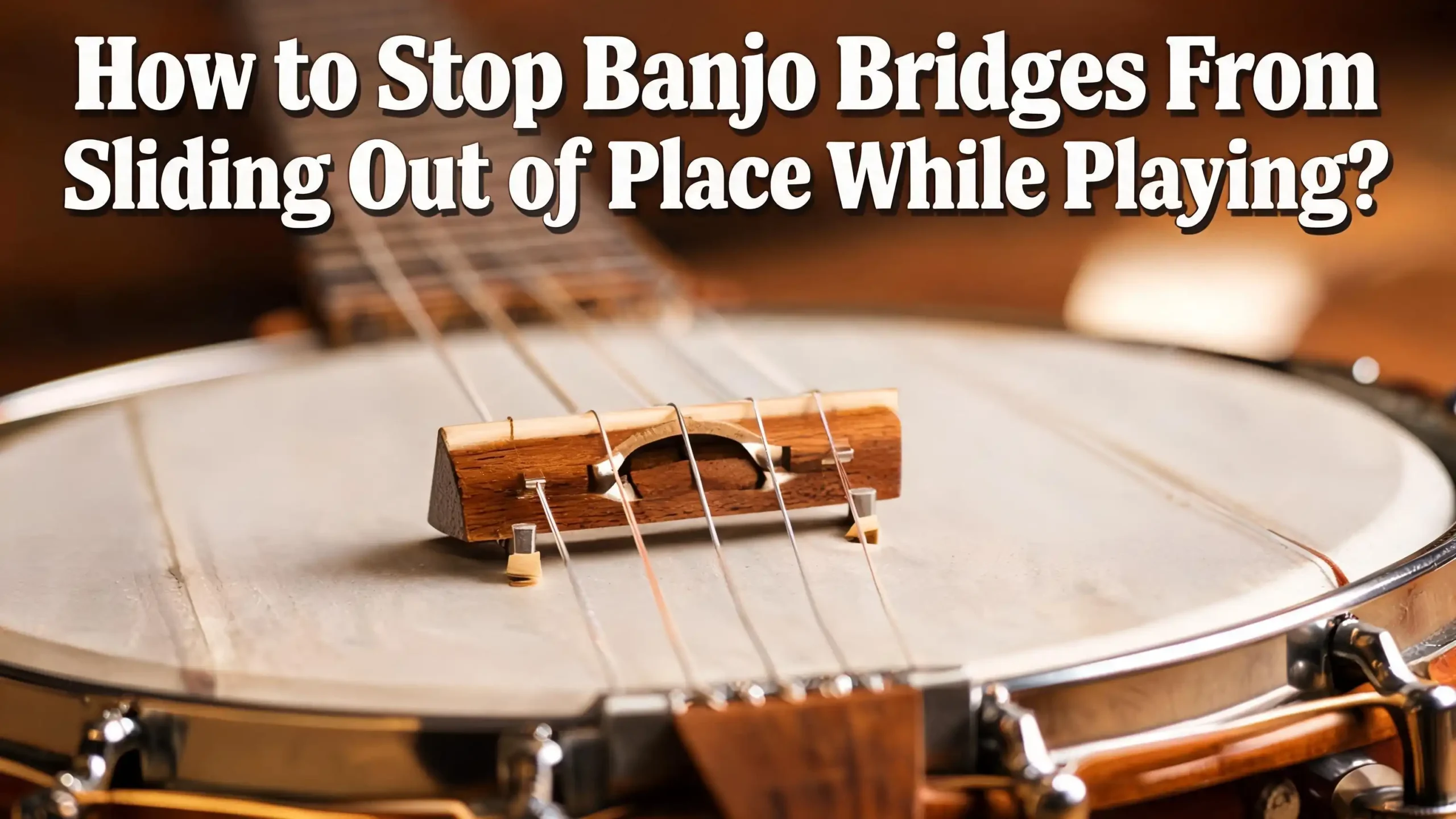
How to Stop Banjo Bridges From Sliding Out of Place While Playing?
If you have ever been deep into a bluegrass jam only to find your banjo suddenly sounds horribly off pitch, a sliding bridge is likely the culprit. This is one of the most frustrating problems banjo players face, and it does not matter if you are a beginner or a seasoned picker. The bridge moves, your intonation goes south, and your whole playing session falls apart.
The good news is that this problem is completely fixable. A sliding banjo bridge usually points to one or more specific causes, and each of those causes has a clear, practical solution. You do not need to be a luthier or spend a lot of money to sort this out. Most fixes take only a few minutes with tools you already have at home.
This guide walks you through every single reason your banjo bridge keeps sliding and gives you actionable steps to make it stop. By the time you finish reading, you will know exactly what to check, what to fix, and how to keep your bridge locked in the sweet spot every time you play.
In a Nutshell
- A sliding banjo bridge is almost always caused by a specific mechanical reason such as low head tension, a poor string angle, incorrect neck alignment, or improper playing technique. Identifying the root cause is the first step before applying any fix.
- Banjo head tension plays the biggest role in bridge stability. A loose head allows the bridge feet to sink and reduces the downward friction force that holds the bridge in place. Tightening the head to the correct pitch (around G to G#) is often all it takes to solve the problem.
- The angle at which strings press down on the bridge (break angle) is critical. A shallow break angle reduces the downward force on the bridge feet, making it easy for the bridge to slide. Adjusting the tailpiece and head tension can restore the proper angle.
- Simple DIY fixes like rosin, rubber cement, or double-sided tape on the bridge feet can dramatically improve grip between the bridge and the banjo head without permanently gluing anything down or damaging the instrument.
- Correct bridge placement based on the 12th fret intonation method ensures the bridge sits where the strings want it, reducing the constant lateral pulling force that causes gradual drift during play.
- Playing technique matters more than most beginners expect. Resting your palm directly on the bridge, strumming too aggressively, or anchoring your hand incorrectly can push or pull the bridge out of position even on a perfectly set up banjo.
Why Does a Banjo Bridge Slide in the First Place?
Before jumping into fixes, it helps to understand exactly why the banjo bridge moves. Unlike guitars, banjo bridges are not glued or bolted down. They are held in position entirely by the downward pressure of the strings and the friction between the bridge feet and the banjo head. This is by design because players need to adjust the bridge position to set proper intonation.
The bridge stays put as long as the string tension creates enough downward force and the head surface provides enough friction. When either of those conditions breaks down, the bridge begins to drift. The force pulling the bridge is typically the lateral tension of the strings, and if that force exceeds the friction holding the feet in place, the bridge moves.
Several conditions reduce the friction and holding power of the bridge:
- A banjo head that is too loose
- A smooth, non-frosted head surface
- A very shallow string break angle over the bridge
- A tailpiece positioned too high
- Bridge feet that are worn smooth or not perfectly flat
- Neck misalignment that creates a constant lateral pulling force
Understanding these causes will help you diagnose your specific situation accurately and apply the right fix instead of just guessing.
Check Your Banjo Head Tension First
Head tension is the single most important factor in bridge stability. A loose head is the most common reason beginners and even experienced players struggle with a sliding bridge. When the head is too loose, two problems happen at once. First, the bridge feet can sink slightly into the softer surface, losing flat contact. Second, the overall downward force that presses the bridge feet into the head is reduced because the string angle becomes flatter.
The correct head tension for most five-string banjos is approximately a G to G# pitch when you tap the head about one inch from the tension hoop. You can measure this with a tuner app on your smartphone. Simply open the tuner, hold the phone close to the banjo head, and tap the head lightly with a fingernail or the eraser end of a pencil at multiple points around the rim.
To tighten the head, follow these steps:
- Use a pot wrench or a standard crescent wrench to turn each bracket nut
- Work in a star pattern around the rim, not in a circle, to maintain even tension
- Turn each nut exactly one quarter turn at a time
- Check the pitch with your tuner after each complete round of adjustments
- Stop when the head reads G to G# consistently around the rim
Do not overtighten the head, as this can cause cracking or damage to the head material. Tighten slowly and check often. Once you reach the correct tension, test your bridge again. In most cases, this single fix resolves the sliding problem entirely.
Understand and Improve the String Break Angle
The break angle is the downward angle at which strings cross over the bridge before heading to the tailpiece. A steeper break angle means more downward force on the bridge feet, which translates to better friction and a more stable bridge. A shallow break angle does the opposite.
If you look at your banjo from the side and the strings barely dip down at all from the bridge to the tailpiece, your break angle is too shallow. This is a very common cause of a sliding bridge, especially on beginner instruments where the tailpiece has never been properly adjusted.
Ideal string break angle is generally considered to be around 13 to 15 degrees over the bridge. A retired mechanical engineer and longtime banjo player on Reddit described a simple test: lay a straight metal ruler or similar flat object across the head in front of the bridge. A properly tensioned head should allow you to just barely slide a quarter under the ruler at the bridge point. If there is a larger gap, both head tension and break angle need attention.
To increase the break angle, you need to lower the point where the strings leave the tailpiece, which is achieved by adjusting the tailpiece downward. Most modern banjo tailpieces have an adjustment screw for this purpose. Turning this screw causes the tailpiece nose to drop closer to the head, steepening the string path over the bridge. Make small adjustments and check the string angle each time until you reach a noticeably steeper downward pitch over the bridge.
Adjust Your Banjo Tailpiece Correctly
The tailpiece does far more than just hold the strings. Its angle and height directly control how much downward pressure is applied to the bridge. A tailpiece that is set too high reduces the string break angle and leaves your bridge with very little friction force holding it in place.
Most adjustable banjo tailpieces have a simple screw or lever mechanism. The goal is to bring the string attachment point of the tailpiece as close to the banjo head as possible without allowing it to contact the tension hoop directly. You want the strings to leave the tailpiece at a sharp downward angle, pass over the bridge with significant downward force, and continue to the nut and tuning pegs.
Here is a step-by-step tailpiece adjustment process:
- Loosen the adjustment screw enough to allow the tailpiece to move freely
- Gently push the nose of the tailpiece downward toward the banjo head
- Stop before the tailpiece body touches the rim or hoop
- Retighten the adjustment screw firmly
- Check the string angle from the side view
- Retune the banjo and test the bridge stability
Some banjo players find that even a small downward adjustment to the tailpiece immediately stops bridge movement. The combination of correct head tension and a proper tailpiece angle is powerful. When both are set correctly, it takes considerable force to shift the bridge, which means normal playing will never disturb it.
Apply Rosin to the Bridge Feet for Extra Grip
If your head tension and tailpiece are properly set but the bridge still slides on certain head materials, applying rosin to the bridge feet is a traditional and highly effective solution. This technique has been used by banjo players for generations, particularly on calfskin heads and smooth synthetic heads where friction is naturally low.
Rosin is the same material violin, viola, and cello players use on their bows. It is a natural resin derived from pine trees, and it creates excellent grip between two surfaces. When applied to the bridge feet, it dramatically increases the friction between the bridge and the head without permanently bonding the two surfaces together.
How to apply rosin to your banjo bridge feet:
- Remove the bridge from the banjo by carefully loosening the strings enough to slip it free
- Get a cake of violin rosin from any music store
- Rub the rosin firmly across the flat bottom surface of each bridge foot several times
- You can also scrape a small amount of rosin powder onto a piece of paper and press the feet into it
- Allow the rosin to settle for a minute before reinstalling the bridge
- Replace the bridge under the strings and retune
Some players prefer a variation of this technique by mixing a tiny amount of rosin with a drop of glue and painting it onto the bridge feet, then letting it dry completely. This creates a slightly textured surface that grips even better. Just make sure the dried coating on the feet is smooth enough not to damage the head surface.
Use Rubber Cement on the Bridge Feet
Another widely recommended technique from experienced banjo builders and players is applying a thin coat of rubber cement to the bottom of the bridge feet. This is especially useful when the bridge needs to sit slightly off its natural position due to minor neck alignment issues, and the string tension alone cannot hold it there.
Rubber cement creates a non-permanent sticky surface that grips the banjo head firmly without actually bonding the two materials together. The bridge can still be removed for adjustments, but it will not shift during normal playing.
The correct way to apply rubber cement to bridge feet:
- Remove the bridge from the banjo
- Apply a very thin, even coat of rubber cement to the flat bottom surface of each foot
- Let the rubber cement dry completely. This is important. Wet rubber cement is too slippery
- Once the coat is fully dry, install the bridge back in its correct position
- Press the feet firmly onto the head and retune
- Test the stability by gently pushing the bridge with your finger
The dried rubber cement layer creates a slightly grippy, almost suction-like contact with the head surface. Players on the Banjo Hangout forum report this method as one of the most effective fixes for persistent bridge sliding, particularly on smooth non-frosted heads. Reapply the rubber cement periodically as it can wear off over time with regular use.
Try Double-Sided Tape as a Quick Fix
If you need a fast fix before a gig or jam session, double-sided transparent tape trimmed to fit the bridge feet is an excellent temporary solution. This technique is widely used among players and has been discussed in depth on Banjo Hangout forums as one of the cleanest non-permanent fixes available.
The advantage of double-sided tape is that it is inexpensive, readily available, easy to apply, and does not affect the acoustic properties of the banjo in any meaningful way. The tape does not add any significant mass to the bridge and does not change the contact surface enough to alter tone.
Steps to apply double-sided tape:
- Cut strips of clear double-sided tape to match the exact footprint of each bridge foot
- Peel the protective backing from one side and press each strip firmly onto the bottom of the foot
- Make sure the tape is flat and does not extend beyond the edges of the feet
- Remove the other protective backing layer
- Place the bridge in its correct position on the head and press down firmly
- Retune and test stability
Keep in mind that this is a temporary solution. The adhesive will eventually degrade and the tape will need replacement. For a permanent fix, rubber cement or rosin applied to the feet is a better long-term approach. But for a quick solution that works in a pinch, double-sided tape is hard to beat.
Mark the Correct Bridge Position With a Pencil
Even if your bridge is not constantly sliding during play, knowing exactly where it should sit saves you a lot of time and frustration after string changes, transport, or any situation where the bridge gets knocked out of place. Many experienced players use a simple pencil marking technique to create a permanent reference point.
A sharp pencil trace around the bridge feet creates a very light, easily visible outline on the banjo head. This line does not damage the head in any way and can be lightly erased if you ever need to reposition the bridge after an intonation adjustment.
How to mark your bridge position:
- Set your bridge to the correct intonation position using the 12th fret method described in the next section
- Hold the bridge firmly in place so it does not shift
- Use a sharp pencil to trace lightly around the outside edge of each foot
- Lift the bridge carefully and examine the marks
- These marks now serve as a permanent guide to reposition the bridge instantly
This technique is especially valuable for calfskin heads and older banjos where finding the correct intonation spot takes considerable time. Some players combine this marking method with the rubber cement or rosin application so that the bridge returns to the exact same spot every time it is reinstalled.
Set Bridge Placement Correctly Using the 12th Fret Method
A bridge that is placed in the wrong position will drift constantly because the string tension is always pulling it back to the mathematically correct intonation point. If your bridge is fighting against the strings to stay where it is, no amount of rubber cement or rosin will keep it there permanently.
The correct bridge placement for a banjo is based on the scale length. The bridge must be placed at exactly the same distance from the 12th fret as the 12th fret is from the nut. This doubles the speaking length of the string at the 12th fret, which is required for the harmonic and fretted note to be in tune with each other.
How to set the bridge using the 12th fret method:
- Measure the distance from the nut to the center of the 12th fret
- Mark that same distance forward from the 12th fret
- This is your approximate bridge position
- Place the bridge at this location and tune the banjo to pitch
- Play a natural harmonic at the 12th fret by lightly touching the string directly above the fret without pressing down
- Then fret the string normally at the 12th fret and play it
- If the fretted note is sharp, move the bridge slightly away from the neck
- If the fretted note is flat, move the bridge slightly toward the neck
- Repeat for each string, noting that the bridge may need to be angled slightly
For a standard five-string banjo with a 26.25-inch scale, the bridge sits approximately 26 and 3/16 inches from the nut. However, always verify with the harmonic method rather than relying on measurements alone.
Check Neck Alignment and Its Effect on Bridge Movement
One of the most overlooked causes of a persistently sliding bridge is a slight neck misalignment. If the neck is not perfectly centered on the rim, the strings will pull the bridge to one side or the other constantly. No amount of friction-based fixes will hold the bridge in position indefinitely if the geometry is fundamentally off.
To check neck alignment, loosen all the strings and remove the bridge. Then tighten only the third string back to pitch. That string should run in a perfectly straight line from the nut all the way down to where the tailpiece holds it, passing directly over the center of the neck at the heel. If that string drifts to one side, the neck is out of alignment.
Minor alignment issues can be addressed by:
- Adjusting the tailpiece laterally if your model allows it
- Using the rubber cement technique to hold the bridge in its functional position even if that position is slightly off-center
- Consulting a professional luthier for a heel recut if the misalignment is severe
Well-known banjo players and builders on Banjo Hangout describe this as the single most common hidden cause of bridge drift on otherwise well-maintained instruments. It is particularly common on factory-built instruments where the neck-to-rim joint was not cut with perfect precision.
Fix Your Playing Technique to Prevent Bridge Movement
Sometimes the bridge itself is not the problem. The way you play can push or pull the bridge out of position regularly, and no mechanical fix will solve a technique problem. This is especially common among beginners who come from guitar and carry over habits that do not work on banjo.
The most common technique-related cause of bridge movement is resting the palm or side of the hand directly on the bridge. On a guitar, the bridge is fixed firmly in place and can take the weight of your hand. On a banjo, the unfixed bridge cannot. Even moderate hand pressure applied to the top of the bridge will push it out of position within a few minutes of playing.
Proper right-hand technique on banjo involves:
- Keeping your palm hovering lightly above the head, not resting on the bridge
- Anchoring your ring finger and pinky finger onto the banjo head slightly behind or beside the bridge
- On three-finger style, your picking hand floats above the strings driven by finger movement, not wrist pressure
- On clawhammer style, the wrist drops toward the head but the palm never presses on the bridge directly
- Strumming with appropriate force. Overly aggressive strumming increases lateral string vibration which can gradually shift the bridge
Watch videos of experienced banjo players closely and pay attention to where their right hand rests during play. You will notice that no skilled player rests any weight on the bridge itself. Developing this habit early will save you from constant bridge repositioning and will also improve your tone and picking clarity at the same time.
Inspect and Maintain Your Bridge Feet Regularly
The condition of the bridge feet has a direct impact on how well the bridge grips the head. Over time, the feet can become worn, rounded, or uneven, which reduces the surface contact area and makes sliding far more likely. A fresh, flat foot surface grips the head significantly better than a worn or damaged one.
To inspect your bridge feet, remove the bridge and look at the bottom surface of each foot under good lighting. The feet should be perfectly flat, with clean, sharp edges and no rounding or uneven wear patterns. If you see any curvature, worn spots, or areas where the wood has compressed unevenly, the feet need attention.
Light sanding can restore flat bridge feet:
- Place a sheet of 400 grit sandpaper on a perfectly flat surface such as a piece of glass or a machined steel block
- Hold the bridge by the top and press the feet flat onto the sandpaper
- Draw the bridge across the sandpaper using light, even pressure in one direction
- Check the feet frequently to ensure you are removing material evenly
- Stop when the feet show a clean, flat, uniform surface
- Finish with 600 grit sandpaper for a smoother surface
After restoring flat feet, apply rosin or rubber cement as described earlier to maximize grip. A freshly flattened foot combined with a rosin coating grips the banjo head far better than a worn foot with no treatment.
Consider the Type of Banjo Head You Are Using
Not all banjo heads offer the same grip surface, and the type of head you have can significantly affect how easily your bridge slides. There are several types of banjo heads commonly used, and they differ in texture, material, and grip characteristics.
Frosted heads have a slightly rough, matte surface texture that provides good natural grip for bridge feet. Most standard five-string banjos come equipped with a top-frosted head, and players find that bridges stay put much more reliably on these surfaces compared to smooth heads.
Clear or non-frosted heads have a smooth, slick surface that offers much less friction. Bridges are noticeably harder to keep in place on these heads, and players using them almost always need to use rosin, rubber cement, or double-sided tape on the bridge feet to compensate.
Renaissance heads have a warm, slightly textured surface that falls between clear and frosted heads in terms of grip. Many players report good bridge stability on Renaissance heads when combined with correct head tension and a proper string angle.
Calfskin heads are the most traditional choice and provide excellent natural grip. However, they are sensitive to humidity and require more maintenance. If you play a banjo with a calfskin head and your bridge is sliding, rosin on the feet is the traditional fix that banjo players have used for well over a century.
If you are still having persistent sliding issues after trying all the fixes described in this guide, switching to a top-frosted synthetic head is worth considering. It is one of the most reliable base surfaces for keeping a bridge firmly in place.
When to See a Professional Luthier
Most banjo bridge sliding problems are solvable at home with simple tools and materials. However, there are situations where professional help is the right call. If you have worked through every step in this guide and your bridge still slides persistently, the issue may involve something you cannot fix yourself without specialized tools and experience.
Consider taking your banjo to a professional luthier if:
- The neck alignment is significantly off and requires a heel recut
- The head is cracked, damaged, or bulging and needs full replacement
- The coordinator rod or dowel stick is bent or misaligned
- The tailpiece mounting is damaged or the tailpiece cannot be properly adjusted
- You notice severe bellying of the head under the bridge
A good luthier will diagnose the underlying issue quickly and give you a clear repair estimate. A professional setup on a banjo typically costs between $50 and $100 depending on the work required, and it can completely transform how the instrument plays and how stable the bridge remains under normal playing conditions.
Do not hesitate to seek professional help if you feel out of your depth. A properly set up banjo is a joy to play, and the investment in a professional setup is absolutely worth it for any instrument you plan to play seriously.
FAQs
Is it normal for a banjo bridge to move a little when I push it by hand?
Yes, some movement is completely normal because the bridge is not permanently fixed to anything. It is held in place only by string pressure and friction. However, it should not move during normal playing once the strings are at full tension. If it shifts while you are playing, that is a sign that something needs to be adjusted.
Can I glue my banjo bridge to the head permanently?
It is not recommended to permanently glue the bridge to the head. The bridge needs to be repositioned periodically for intonation adjustments, and a permanently glued bridge also transfers vibrations differently, which can negatively affect your tone. If you want something more permanent, use rubber cement on the feet, which grips firmly but still allows removal without damage.
How do I know if my banjo head tension is correct?
Tap the head about one inch from the tension hoop with your fingernail or a pencil eraser, and check the pitch with a tuner app. The head should read around G to G# for most five-string banjos. If it reads lower than that, the head is too loose and needs tightening.
How often should I check my bridge position?
Check your bridge position every time you change strings, after transporting the banjo, and at the beginning of any important playing session. It only takes a few seconds to verify the position using your pencil marks, and catching a drifted bridge early saves you from playing out of tune without realizing it.
My bridge always drifts to the same side. What does that mean?
Consistent one-directional drift usually indicates a neck alignment issue. The strings are not traveling in a perfectly straight line from nut to tailpiece, so they are applying a constant lateral force on the bridge. Check your neck alignment using the third-string method described in this guide, and consider having a luthier look at the heel cut if the drift is significant.
Does the type of strings I use affect bridge stability?
Yes, heavier gauge strings produce more tension and create more downward force on the bridge, which generally improves stability. Very light strings produce less downward force, which can make bridge sliding slightly more likely, especially if other factors like head tension or break angle are not optimal. Lighter strings also require a shallower tailpiece angle to avoid excess pressure on the head.
What is the best material for a banjo bridge to prevent sliding?
The bridge material itself does not greatly influence sliding. What matters more is the condition and flatness of the feet, and what you apply to them. A maple and ebony bridge with freshly flattened feet and a rosin or rubber cement coating will grip the head far better than a worn bridge of any material.

Hi, I’m Tessa! As a lifelong music lover and gear enthusiast, I started this blog to help fellow musicians navigate the overwhelming world of instruments and equipment. I spend my time researching, comparing, and reviewing musical gear so you can spend yours doing what matters most — making music.