What to Do When a Piano Key Sinks and Does Not Bounce Back?
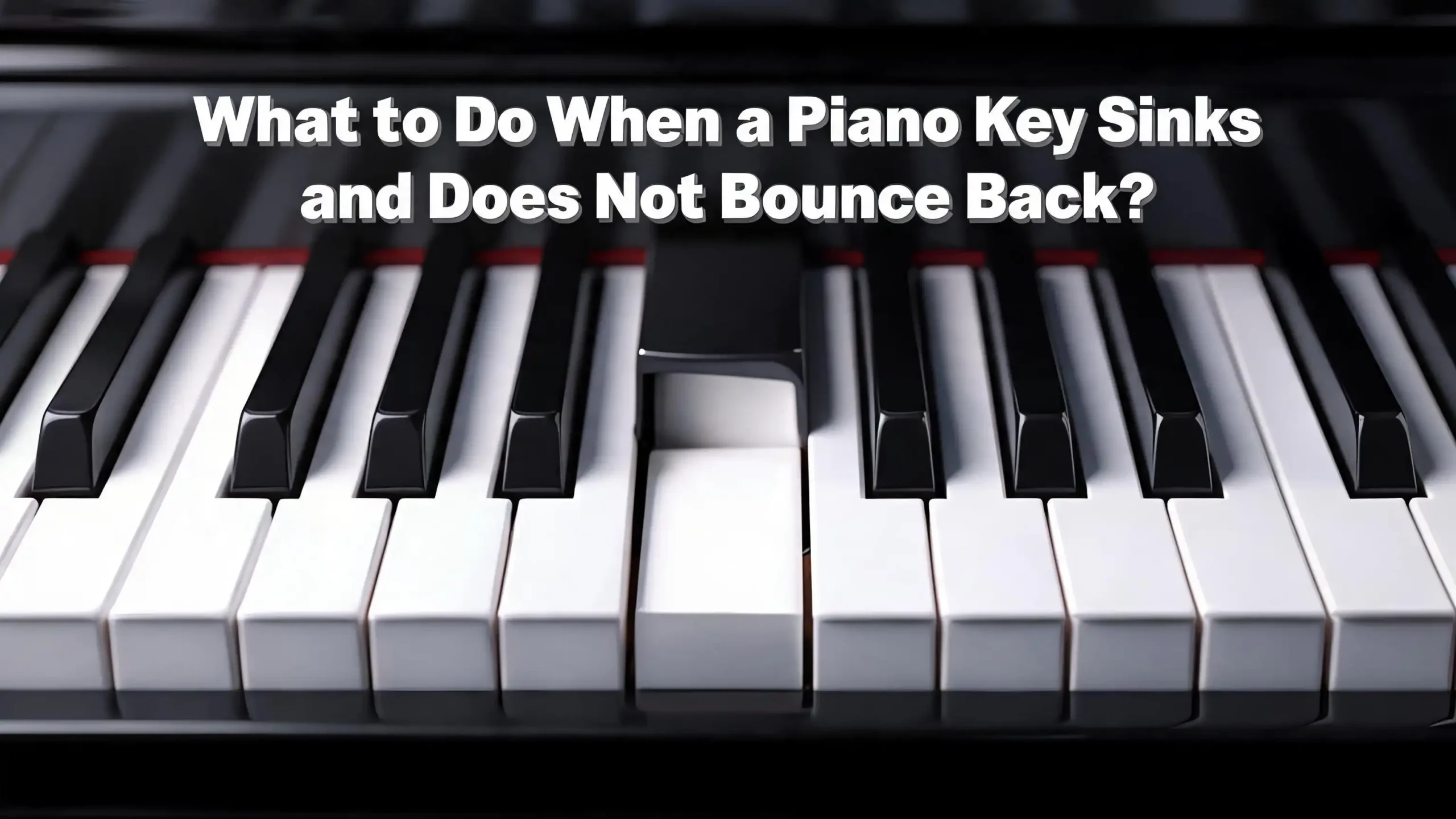
You press a key, and it stays down. It does not spring back up like it should. The note rings out or goes silent, and you are left staring at a sunken key that refuses to return to its resting position. This is one of the most common and frustrating problems piano owners face, whether you play an upright, a grand, or a baby grand.
The good news? A piano key that sinks and does not bounce back is almost always fixable. The cause might be as simple as a coin wedged between two keys or as involved as a swollen felt bushing gripping a rail pin too tightly. Either way, you do not need to panic, and you do not always need to call a technician right away.
This guide walks you through every possible cause and solution for a piano key that will not return after being pressed. By the end, your stuck key should be back in action, and you will have the knowledge to prevent this from happening again.
Key Takeaways
- A stuck piano key usually has a simple, identifiable cause. The most common reasons include swollen felt bushings, corroded rail pins, foreign objects lodged between keys, a misaligned key slip, a broken jack spring inside the action, or a cracked key stick. Each of these problems produces the same symptom but requires a different fix.
- Humidity is the number one environmental factor behind keys that sink and stay down. Wood and felt inside the piano absorb moisture from the air, causing parts to swell and bind against metal pins. Keeping room humidity between 40% and 60% prevents most sticking problems before they start.
- Many fixes are safe to perform at home with basic tools and careful handling. Gently rocking a stuck key side to side, removing debris, cleaning corroded pins with a soft cloth, and adjusting the key slip are all within reach for most piano owners.
- Some repairs require a trained piano technician. If multiple keys stick at once, if internal springs are broken, if felt bushings need full replacement, or if key sticks are cracked, a professional should handle the work to avoid further damage.
- Regular maintenance prevents recurrence. Cleaning your keys weekly, scheduling annual tuning visits, and monitoring your room’s humidity level will keep your piano’s action running smoothly for years.
How a Piano Key Returns After Being Pressed
Understanding how a piano key works makes it much easier to figure out why one stays down. A piano key is a lever. The front of the key (the part you press) goes down, and the back of the key rises up. That rising back end pushes the action mechanism, which sends the hammer forward to strike the string.
When you release the key, gravity and the weight of the back end of the key pull it back to its resting position. The key pivots on a balance rail pin, and felt bushings allow smooth movement on both the balance pin and the front rail pin. Springs inside the action, especially the jack spring, also help components reset.
If anything along this chain of movement binds, sticks, swells, corrodes, or breaks, the key will not return properly. The problem can exist at the key level, the pin level, or deep inside the action mechanism. Diagnosing where the issue lives is the first and most important step.
A piano has roughly 12,000 individual parts, and the action is regulated to within one thousandth of an inch. Even a tiny disruption can cause a key to stick or sink.
Check for Objects Stuck Between the Keys
The simplest cause is also the most overlooked. Small objects fall between piano keys more often than you might think. Coins, paper clips, pencil tips, eraser shavings, buttons, and even food crumbs can slide into the gaps between keys and prevent one from moving freely.
Start by looking carefully at the stuck key and the keys on either side of it. Press the neighboring keys gently and see if you can spot anything wedged in the gap. Use a flashlight to look into the narrow spaces. If you see an object, try to remove it with a pair of thin tweezers or by gently tilting the piano forward (uprights only, with a helper for safety).
If you cannot see anything from the top, you may need to remove the fallboard. The fallboard is the hinged cover that folds down over the keys. Most uprights have clips or hinges holding it in place. Once the fallboard is removed, you get a much better view of the key bed and the tops of the action.
Never force a stuck key up or down aggressively. The felt, pins, and wooden parts are all very delicate. A gentle investigation almost always reveals the foreign object if one is present.
Examine the Key Slip Position
The key slip is the long, narrow board that runs along the front of the keyboard, just below the white keys. Its job is to protect the front ends of the keys. However, if the key slip shifts or gets pushed too close to the keys, it will physically block them from returning.
Here is a quick test. Press the stuck key down slowly, then use your other hand to pull the key slip gently toward you. If the key immediately pops back up, the key slip is the problem. The front of the key was catching against the slip when pressed.
To fix this, locate the screws or blocks at each end of the key slip. On most upright pianos, the key slip is held in place by two key blocks and a few screws. Remove the screws, slide the key slip out slightly, and place a thin shim (a small piece of cardboard works) between the key slip and the key frame.
Reinstall the key slip with the shim in place. This creates a tiny extra gap that allows the keys to move freely. Do not overtighten the screws, as that can push the slip right back into contact with the keys.
Identify Swollen Key Bushings from Humidity
Humidity is one of the most common causes of piano keys that sink and refuse to return. Each key has felt bushings at two points: the balance rail hole and the front rail hole. These bushings allow the key to glide smoothly up and down on the metal pins.
When room humidity rises above 60%, the felt and wood absorb moisture and swell. The bushings grip the pins too tightly, creating friction that prevents the key from bouncing back. This problem often appears suddenly during rainy seasons or in rooms without climate control.
You can test for this by pressing the stuck key down firmly but slowly, then gently rocking it from side to side while it is depressed. This motion compresses the felt and can temporarily free the key. If the key loosens up after rocking, humidity is almost certainly the cause.
The long term fix involves controlling your room’s environment. Use a hygrometer to monitor humidity and keep the level between 40% and 60%. A dehumidifier in damp climates or a piano humidity control system installed inside the instrument will protect all 88 keys from this problem.
Clean Corroded or Dirty Rail Pins
Each piano key sits on two metal pins. The balance rail pin supports the key at its pivot point, and the front rail pin guides the front of the key. Over time, these pins can develop corrosion, rust, or a buildup of grime from dust and old lubricant.
A corroded pin creates a rough surface that the felt bushing cannot slide on smoothly. The result is a key that goes down but drags or sticks on the way back up. You can feel this by lifting the key slightly and noting if it moves in a gritty or scratchy way.
To clean the pins, first remove the key by lifting it straight up off the pins. Use a soft, lint free cloth and a small amount of metal polish to gently rub each pin until the surface is shiny and smooth again. Wipe off all polish residue before reinstalling the key.
After cleaning, apply a tiny drop of key pin lubricant to each pin. Do not over lubricate, as excess product attracts more dust and will cause the same problem again later. Test the key by pressing it repeatedly to confirm smooth, free movement.
Front rail pins on many pianos are oval shaped. If a technician previously turned the pin to tighten a loose key, it may now be too tight. A small rotation of the pin can fix this, but this adjustment requires experience and the right tools.
Handle a Broken or Cracked Key Stick
The key stick is the entire wooden lever that forms the key itself. It extends from the visible white or black surface all the way back to where it contacts the action. Over time, wood can crack, especially at the balance rail point where stress concentrates.
If the key stick is cracked or broken, pressing the front down will not cause the back end to rise properly. The broken section absorbs the motion instead of transferring it. This means the action never engages correctly, and the key sinks without resistance.
You can check for this by removing the key from the piano and inspecting it visually. Look for hairline cracks, splits, or any visible separation in the wood, especially near the center where the balance pin hole is located.
A cracked key stick is not a DIY repair for most piano owners. The key needs to be professionally glued, clamped, and sometimes reinforced or replaced entirely. A piano technician can source replacement key sticks that match your instrument’s make and model.
If you spot a crack, avoid playing that key until it is repaired. Continued use can worsen the break and potentially damage the action components above it.
Replace a Weak or Broken Jack Spring
Inside the piano’s action mechanism, a small but critical component called the jack spring controls the reset of the hammer after each keystroke. The jack is a small lever that pushes the hammer forward, and the spring pulls it back into position after the key is released.
When this spring weakens or snaps, the jack cannot return to its ready position. The key may go down and feel mushy, or the hammer may not fully reset, causing the key to stay depressed. This is a very common issue in older pianos that have not been serviced in many years.
Diagnosing a broken jack spring requires access to the action. On an upright piano, you can sometimes see the whippens (the assemblies that hold the jacks and springs) by removing the front panel. Look for a spring that appears stretched, bent, or completely missing.
Replacing a jack spring is a precision task. The new spring must match the original in size and tension. While replacement springs are inexpensive, installing them correctly requires small tools and steady hands. Many piano owners prefer to leave this job to a technician to avoid damaging surrounding parts.
If you notice that the key feels different from others, with a soft or lifeless touch, a worn jack spring is a likely suspect.
Address Sluggish Action Parts and Tight Flanges
The action of a piano contains dozens of flanges, which are small hinged joints that allow parts like hammers, whippens, and dampers to move. Each flange has a center pin running through it, and these pins are surrounded by felt or cloth bushings.
When these flange bushings swell from humidity or wear down from age, the action part connected to that flange becomes sluggish. A tight flange will cause the hammer or whippen to move slowly or not at all, which makes the key feel stuck or unresponsive.
Technicians test flanges by removing the action and flicking the hammer or whippen. A properly functioning part should swing back and forth four to six times before stopping. If it barely moves, the flange is too tight. If it swings endlessly, the flange is too loose.
Fixing a tight flange involves either repinning it with a slightly smaller center pin, steaming the bushing to shrink it, or replacing the bushing entirely. This is one of the more advanced repairs and is best left to a qualified piano technician. Attempting to force a tight flange can break the wooden parts around it.
If you notice that several keys in a row are slow to return, especially in a section of the piano that sits near an outside wall or window, flange swelling from humidity exposure is a strong possibility.
Perform Basic Key Easing at Home
Key easing is a gentle technique that compresses swollen felt bushings without removing them. It is one of the safest and most effective home remedies for a key that sinks and does not bounce back due to humidity.
Start by pressing the stuck key all the way down. While the key is depressed, gently wiggle it from side to side. Apply steady, moderate pressure. You are not trying to break anything. You are compacting the felt fibers so they release their grip on the pin.
Repeat this motion ten to fifteen times. Then release the key and test it. In many cases, the key will return freely after just a few rounds of easing. If it still sticks, try the process again with slightly more side to side movement.
For a more thorough approach, remove the key by lifting it straight off the pins. Use a key easing tool or a smooth, rounded object to gently press into the felt inside the bushing holes. This compresses the felt more evenly and provides a longer lasting result.
Key easing is a temporary fix if the humidity problem is not resolved. The felt will swell again during the next period of high moisture. Combine key easing with humidity control for a permanent solution.
Control Your Piano Room’s Humidity and Temperature
Environmental control is the single most effective way to prevent keys from sticking. Pianos are built from thousands of pieces of wood, felt, leather, and metal, and all of these materials respond to changes in humidity and temperature.
The ideal humidity range for a piano room is 40% to 60% relative humidity. The ideal temperature is stable and moderate, generally around 68 to 72 degrees Fahrenheit. Extreme swings in either direction cause the most damage.
Place a digital hygrometer near your piano to monitor conditions. If your room regularly exceeds 60% humidity, invest in a dehumidifier. If it drops below 40%, a humidifier will protect the wood and felt from drying out and cracking.
A dedicated piano climate control system can be installed inside the instrument itself. These systems regulate moisture levels directly around the soundboard and action. Many piano technicians recommend these systems, especially in regions with seasonal humidity swings.
Keep your piano away from exterior walls, heating vents, fireplaces, and windows that receive direct sunlight. All of these heat sources create localized temperature changes that cause uneven expansion and contraction of the piano’s wooden components.
Follow a Regular Cleaning and Maintenance Routine
Consistent care prevents most sticking key problems from developing in the first place. A simple weekly cleaning routine takes only a few minutes and protects your piano’s action from dust, grime, and debris.
Wipe the keys with a soft, slightly damp microfiber cloth two to three times per week. Use lukewarm water with a tiny amount of mild dish soap. Wipe from back to front using vertical strokes, then dry the keys immediately with a second cloth. Avoid cleaners that contain alcohol, bleach, or harsh chemicals, as these damage the key surfaces.
Wash your hands before playing. Oils, lotions, and dirt from your fingers transfer to the keys and eventually work their way down to the pins and bushings. Clean hands significantly reduce buildup over time.
Keep the fallboard closed when the piano is not in use. This prevents dust, pet hair, and small objects from falling between the keys. It also protects the keys from direct light exposure, which can yellow ivory or discolor plastic over time.
Schedule a professional tuning and inspection at least once per year. During these visits, the technician will check the action, clean the pins if needed, and catch small problems before they turn into stuck keys. New pianos benefit from four tunings in the first year as the strings and soundboard settle.
Know When to Call a Professional Technician
Some piano problems are beyond what a careful owner should attempt at home. Recognizing these situations saves you time, money, and the risk of accidental damage to your instrument.
Call a professional if the stuck key does not respond to basic cleaning, key easing, or debris removal. Multiple keys sticking at the same time usually point to a systemic issue like widespread bushing swelling, corroded pins throughout the key bed, or action regulation problems that require specialized tools.
A technician should also handle any work inside the action mechanism. Replacing jack springs, repinning flanges, adjusting hammer alignment, and replacing key bushings all require training and precision tools. Action parts are regulated to extremely tight tolerances, and incorrect adjustments can create new problems.
Look for a technician who is a member of the Piano Technicians Guild or has formal training in piano technology. Ask about their experience with your specific piano brand. A good technician will explain what they find, discuss your options, and give you a clear cost estimate before starting any work.
Professional tuning and regulation typically costs between $100 and $250 per visit, depending on location and the scope of work. Full action regulation for a grand piano can take six to ten hours. This investment protects both the playability and the long term value of your instrument.
Understand the Difference Between Upright and Grand Piano Key Issues
The same symptom, a key that sinks and stays down, can have different causes depending on whether you own an upright or a grand piano. The action mechanism is oriented differently in each type, which affects how gravity and mechanics interact.
In an upright piano, the hammers move horizontally. Springs play a larger role in returning the action parts to rest, so a broken spring is more likely to cause a stuck key in an upright. The key slip is also more prone to shifting on uprights because of how the front panel is constructed.
In a grand piano, the hammers move vertically, and gravity helps them fall back into place. Grand pianos rely more heavily on precise regulation and the weight of their own parts for key return. A stuck key on a grand is more often caused by tight bushings, swollen flanges, or friction on the repetition lever.
Removing the action from a grand piano involves sliding the entire keyboard and action assembly forward on rails. This is a delicate process, and the action can be damaged if handled improperly. On an upright, the action lifts out from the top after removing the front panels.
No matter which type of piano you own, the diagnostic process starts the same way. Check for debris, test the key slip, feel for friction on the pins, and listen for unusual sounds. Then narrow down the cause based on what you find.
Prevent Future Key Sticking Problems
Prevention is always easier than repair. A few simple habits will dramatically reduce the chances of a piano key sinking and refusing to bounce back.
First, maintain stable room conditions. Sudden changes in humidity and temperature are the leading cause of sticking keys. Use a hygrometer, control your climate, and position the piano in a stable part of the room away from drafts, vents, and sunlight.
Second, keep the area around and above the piano clear. Do not place drinks, pencils, coins, or other small items on the piano. Anything that can fall between the keys eventually will.
Third, schedule regular professional maintenance. Annual tuning visits give your technician a chance to inspect the action, clean the pins, and address small issues before they become bigger problems. Pianos that go years without service are far more likely to develop multiple sticking keys.
Fourth, play the piano regularly. Keys that sit unused for long periods are more likely to develop sticking problems because the felt stays compressed in one position and dust settles into the mechanism. Regular playing keeps everything moving and helps you notice problems early.
Finally, keep the fallboard closed when you are not playing. This single habit prevents most debris related key problems and protects the keys from environmental exposure.
Frequently Asked Questions
Why does my piano key go down but not come back up?
The most common reasons are swollen felt bushings, a corroded balance or front rail pin, a foreign object wedged between keys, a misaligned key slip, or a broken jack spring inside the action. Humidity is the leading environmental cause. Start by checking for debris and testing the key slip. If the key still sticks, the issue is likely inside the bushings, pins, or action.
Can I fix a stuck piano key myself without calling a technician?
Yes, in many cases. You can safely remove debris, adjust the key slip, ease swollen bushings by gently rocking the key side to side, and clean corroded pins with a soft cloth and metal polish. These basic fixes solve the majority of sticking key problems. However, if the issue involves broken springs, cracked key sticks, or tight flanges inside the action, a professional should handle the repair.
How does humidity cause piano keys to stick?
Piano keys have felt bushings that sit on metal pins. When humidity rises above 60%, the wood and felt absorb moisture and swell. The bushings grip the pins more tightly, creating friction that prevents the key from returning to its resting position. Controlling room humidity between 40% and 60% with a hygrometer and a dehumidifier or humidifier prevents this problem.
How much does it cost to fix a sticking piano key?
A basic tuning and inspection visit costs between $100 and $250. If the fix involves cleaning pins or easing bushings, the cost is usually included in a standard service call. More involved repairs like replacing key bushings, repinning flanges, or replacing jack springs will cost more depending on the number of keys affected and the labor required. Ask your technician for an estimate before authorizing any work.
How often should I have my piano serviced to prevent sticking keys?
Schedule professional tuning and inspection at least once per year. Pianos in high use or in rooms with fluctuating humidity may benefit from twice yearly visits. New pianos should be tuned four times during their first year. Regular service catches small problems early and keeps the action regulated for smooth, responsive play.
Is a sticking key a sign that my piano needs major repair?
Not usually. A single sticking key is almost always a minor issue caused by humidity, debris, or a worn component. However, if many keys are sticking at the same time, if the problem returns repeatedly after fixing, or if you hear unusual sounds from the action, a deeper issue like full action regulation or widespread bushing replacement may be needed. A qualified technician can assess the scope of the problem during a service visit.

Hi, I’m Tessa! As a lifelong music lover and gear enthusiast, I started this blog to help fellow musicians navigate the overwhelming world of instruments and equipment. I spend my time researching, comparing, and reviewing musical gear so you can spend yours doing what matters most — making music.